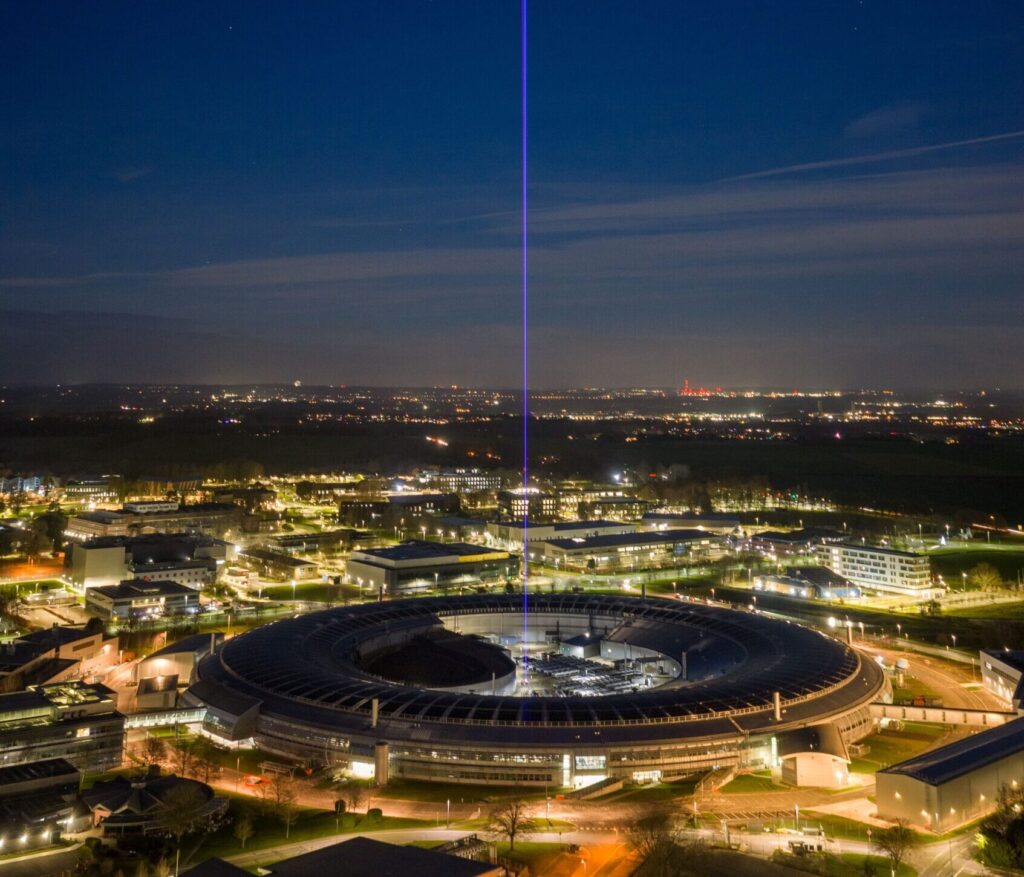
Harwell Science and Innovation Campus celebrated its 80th birthday, marking eight decades of world-leading science and innovation with a dazzling spectacle visible across Oxfordshire.
The UK’s most powerful display laser shone from the centre of the iconic Diamond Light Source, creating ‘The Beam’— a vertical pillar of light in the night sky, visible to people across the region.
The Beam created a striking visual celebration of the campus’ world-leading expertise in light-based science. Operated by Horizon Lasers, The Beam was 2.2 million times more powerful than a typical laser pen, yet still far less powerful than the lasers routinely used by the national research facilities operated by the Science and Technology Facilities Council at Harwell Campus.
The Central Laser Facility, one of 15 national facilities on the campus, was in the process of upgrading its most powerful laser. The Vulcan 20-20 upgrade programme was set to deliver a laser beam with a power output of 20 petawatts (equivalent to 200 billion kilowatts). This twentyfold increase in power would create, in a single pulse, enough energy to recreate the extreme conditions of deep space. The upgraded laser at CLF was expected to be 18 trillion times more powerful than the laser used for The Beam on New Year’s Day.
Professor John Collier, Director of CLF, said: “Vulcan has been the flagship laser at CLF for many years and is widely recognised internationally as a pioneering research facility. This major upgrade of Vulcan will help secure UK leadership in High Energy Density Science, as well as offering UK industry and researchers access to advanced technology development to aid UK growth. The Beam was a powerful reminder of the vital role the national facilities at Harwell Campus continue to play in advancing knowledge, technology and innovation on the world stage.”
Light had been at the heart of Harwell’s mission since its earliest days. From the pioneering Central Laser Facility (CLF) and the cutting-edge advances at its Extreme Photonics Applications Centre, to Diamond Light Source’s revolutionary X-ray crystallography and the Rosalind Franklin Institute’s breakthrough microscopy, light had fuelled discovery on the campus for decades.
Jim Stretton, Managing Director at Harwell Campus, said: “Harwell Campus has a remarkable heritage, where generations of scientists have pushed boundaries, challenged conventions, and shaped the technologies that define our world today. As we celebrated 80 years of discovery, the strength of the public–private partnership that underpins the campus was central to its continued success and evolution. The Beam honoured Harwell’s past scientific breakthroughs while signalling the next era of growth and innovation. Our ongoing investment in world-leading research facilities, from next-generation lasers to advanced imaging, ensures Harwell Campus remains at the forefront of global discovery.”
Professor Gianluigi Botton, Chief Executive Officer at Diamond Light Source, the UK’s national synchrotron, added: “At Diamond, we harness the power of synchrotron light to reveal the structure of everything from viruses and vaccines to new materials and advanced technologies. The Beam marked 80 years of discovery and reflected the campus’ ongoing commitment to collaboration, innovation, and using light to transform the way we understand the world. We were delighted to play our part on New Year’s Day in marking this momentous occasion.”
The Beam was part of The Light Project and kicked off a series of events planned across 2026 to mark Harwell’s 80th anniversary. The campus (home to over 7,000 researchers and innovators across 250 organisations), a joint venture between the UK Government (UKAEA and UKRI-STFC) and Brookfield, continued to strengthen its position as the UK’s most important science and innovation destination. A strategic national asset and home to the UK’s largest concentration of national research facilities, the campus had been at the forefront of discovery for eight decades, from the nation’s first nuclear research laboratories to today’s breakthroughs in space, quantum, energy and life sciences.
Photo Credit : James Singleton