Harwell Campus and Diamond Light Source, the UK’s national synchrotron, have unveiled ‘Fragments’, a new public interactive artwork inspired by the pioneering scientific discoveries taking place on campus, celebrating innovation while providing an engaging space for campus members, visitors and the local community.
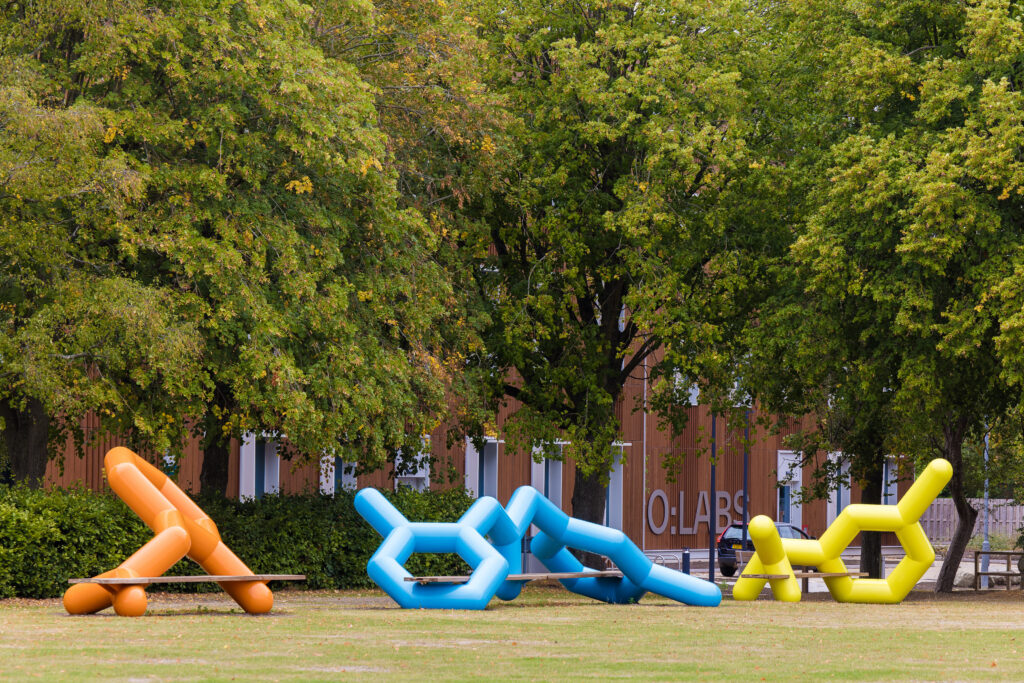
Fragments is a series of three striking large-scale sculptures, inspired by protein-ligand crystal structures – tiny chemical fragments that bind to proteins and form the foundation of many life-saving medicines. Created by design studio Acrylicize in collaboration with James Sandy, Senior Beamline Scientist at Diamond Light Source, the installation transforms complex molecular science into a bright, accessible public artwork that celebrates the discoveries shaping the medicines of tomorrow. The sculptures are over two billion times larger than the fragments themselves.
Positioned around the campus cricket pitch, the colourful steel sculptures are designed to be explored. Functioning as places to sit, meet, reflect and play, the installation forms part of Harwell Campus’ continued investment in creating an inspiring environment where science extends beyond the laboratory, bringing together world-class research, art and public spaces.
A key inspiration behind Fragments was the Covid Moonshot project. Scientists at Diamond Light Source used the synchrotron to determine the three-dimensional structure of a key coronavirus protein known as Mpro, which enables the virus to replicate. Working alongside researchers from the University of Oxford and the Weizmann Institute of Science, the team screened thousands of chemical fragments using crystallography and mass spectrometry, identifying more than 70 protein-ligand crystal structures capable of binding to the protein and potentially blocking its activity.
The findings were shared through the Covid Moonshot project, helping to develop the world’s first crowdsourced coronavirus antiviral while creating one of the world’s largest open datasets for antiviral drug discovery, enabling researchers worldwide to accelerate the development of future medicines. Today, those microscopic molecular structures have been reimagined at monumental scale, creating a permanent reminder of how curiosity-led research at Harwell can deliver discoveries with global impact.
Rebecca Duvall, Head of Community at Harwell Campus, said: “At Harwell, we’re committed to creating a campus that inspires curiosity as much as scientific discovery. Fragments celebrates the breakthroughs that have changed lives around the world while creating a shared space where our community and visitors can engage with science in a new and meaningful way.”
James Sandy, Senior Beamline Scientist at Diamond Light Source, said: “The molecular structures represented in Fragments were identified through a collaborative effort involving scientists and facilities from around the world. It’s wonderful to see that research brought into the public realm in such an imaginative way. The sculptures provide a tangible connection between the fundamental science taking place at Diamond and its potential to improve lives through the development of new medicines.”
The installation continues the shared commitment of Harwell Campus and Diamond Light Source to creating public spaces that reflect the pioneering work taking place across the campus’ community of more than 250 organisations. As the UK’s leading science and innovation campus, Harwell continues to demonstrate that world-changing research thrives in places where collaboration, creativity and community are designed to flourish together.