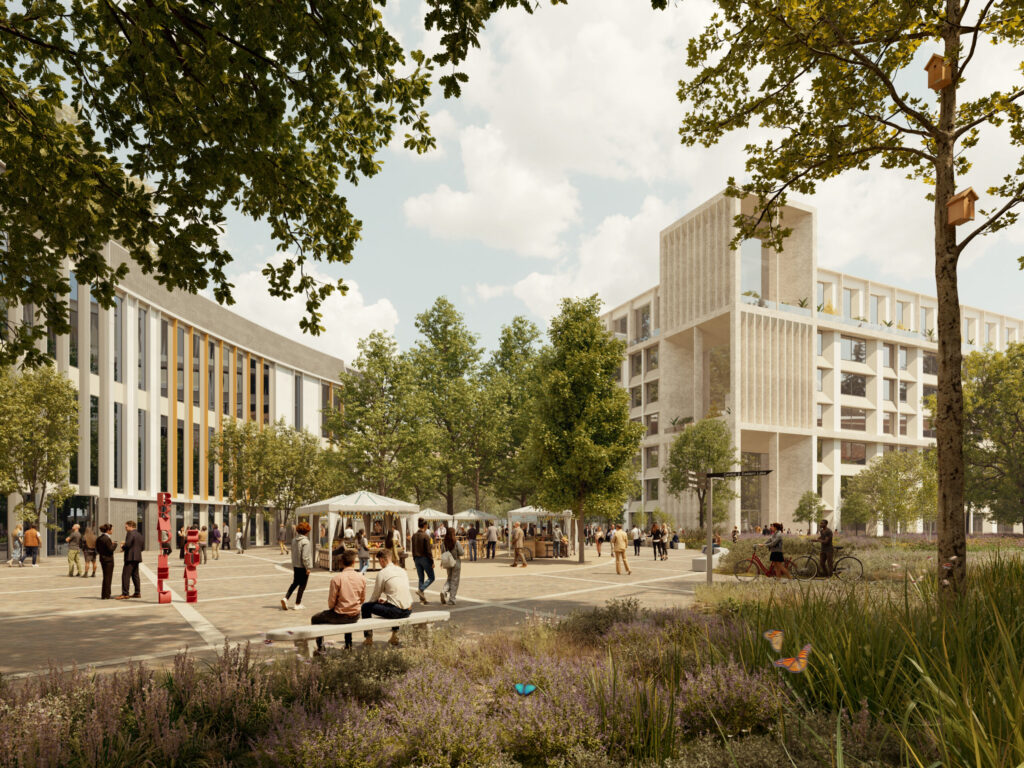
Cambridge Science Park has submitted its masterplan for planning consent, outlining a generational opportunity for British economic growth. Trinity’s plans will unlock £1bn of planned investment by the college and its leasehold partners, with a further £2bn expected over the course of a 30 year period. This could see the Park’s annual gross value added rise from £1 billion to over £3 billion.
The 152-acre site in north Cambridge, founded by Trinity College Cambridge in 1970 is the UK’s oldest science park. It has quietly powered breakthroughs like the chip in your phone, cancer drugs and Bluetooth technology. For over 50 years, it has turned world-class science into jobs, investment and exports, generating approximately £1 billion in gross value added each year at more than twice the national productivity average. It directly employs over 7,000 people, with a GVA per employee of £139,000, 65 per cent above the wider Cambridge figure, making it critical to both local and national economic infrastructure.
This privately funded masterplan will increase built space from 2.8 million to approximately 8 million square feet, delivering around 20,000 additional high-skilled jobs in life sciences, technology and clean energy. These roles will birth industries that do not yet exist, keeping Britain competitive against America and Asia in sectors defining the next century. The expansion aligns with government ambitions, including the Chancellor’s January 2025 vision for the Oxford-Cambridge Growth Corridor as Europe’s Silicon Valley, backed by £500 million and the Cambridge Growth Company.
Beyond jobs and output, the project will create a new, public Park of Science with green routes, lakes and biodiverse spaces to foster collaboration, an outdoor museum of science alongside places to meet and eat. Improved transport via busways and rail will cut car dependency. It commits to local education through apprenticeships and skills programmes, ensuring benefits reach communities from Kings Hedges to Peterborough.
Jane Hutchins, Director, External Relations at the Science Park, said:
“Innovation at Cambridge Science Park has already changed how billions of people live their lives, from groundbreaking cancer drugs to bluetooth technology. Now our masterplan scales that success to deliver threefold economic growth and up to 20,000 new jobs.
“This privately funded project provides certainty rare in modern development and has the potential to be a key component of the UK’s future economic growth. With approval, we cannot wait to see the industries of the future being created here in Cambridge.”
Dame Sally Davies, Master of Trinity College, said:
“We are immensely proud of the Cambridge Science Park and the remarkable way it has impacted the lives of billions around the globe since its foundation by the college over five decades ago.
“That ambition remains. We know that if the Science Park is to continue to serve the needs of people around the world, it must continue to grow.
“That is why we are submitting a masterplan for the next half century of growth, as a vibrant, collaborative and inspiring place to learn, to work and to enjoy. This plan will see as many as 27,000 people working at Cambridge Science Park, whilst opening up the new Park of Science to the young people and families of Cambridge and the towns and villages around.
“Our plans will ensure that the Cambridge Science Park, like our college and university, continues to stand testament to the power of collaboration: between scientists, between educators and children, between business and research, and between the generations – the scientists of today and those who will meet our world’s pressing needs tomorrow.”
Roland Sinker, Chairman of Innovation & Growth, University of Cambridge, said:
“As the UK’s oldest and largest science park, Cambridge Science Park has been a cornerstone of the Cambridge Phenomenon for over half a century. It has been critical in transforming our city from a historic place of learning into a global centre of scientific and technological innovation.
“This masterplan sets the direction for the next 50 years, shaping a place where world-class innovation can thrive in an environment that is open, sustainable and welcoming to all.
“By opening the Park of Science and widening access to STEM opportunities for local children, the Science Park will inspire the next generation of innovators. It will be a place where curiosity is sparked early and ambition can grow. From school pupils to leading researchers, this is where people can be inspired to pursue ideas that change lives – advancing the mission of the University to serve society through discovery and knowledge.
“Nationally, the masterplan is a strong vote of confidence in the UK as a science and technology leader. The Park’s expansion will create thousands of high quality jobs, contribute billions to the national economy, and help ensure that the breakthroughs of the future are developed here in the UK.
“This project reflects the strength of collaboration between the University, Trinity, the wider collegiate community and our partners in local and national government. Together, as long-term stewards of Cambridge’s future, we are ensuring our city remains the best place in the world to innovate, while delivering real prosperity for the region and the country as a whole.”
Neil Tween, CFO of Owlstone Medical who are based at the Park, said:
“The Cambridge Science Park has been key to our growth – from a university spin-out to a global leader in breath biopsy. It has provided us with access to continued talent and space, and the reputation of the Park has helped position the business for success.
“The Park’s continued redevelopment is vital to ensuring companies like Owlstone can start and scale here in the UK.”